Choosing remote online notarization Florida
Choose remote online notarization Florida with confidence. Review requirements, trust signals, and practical steps before booking a session in Orlando.
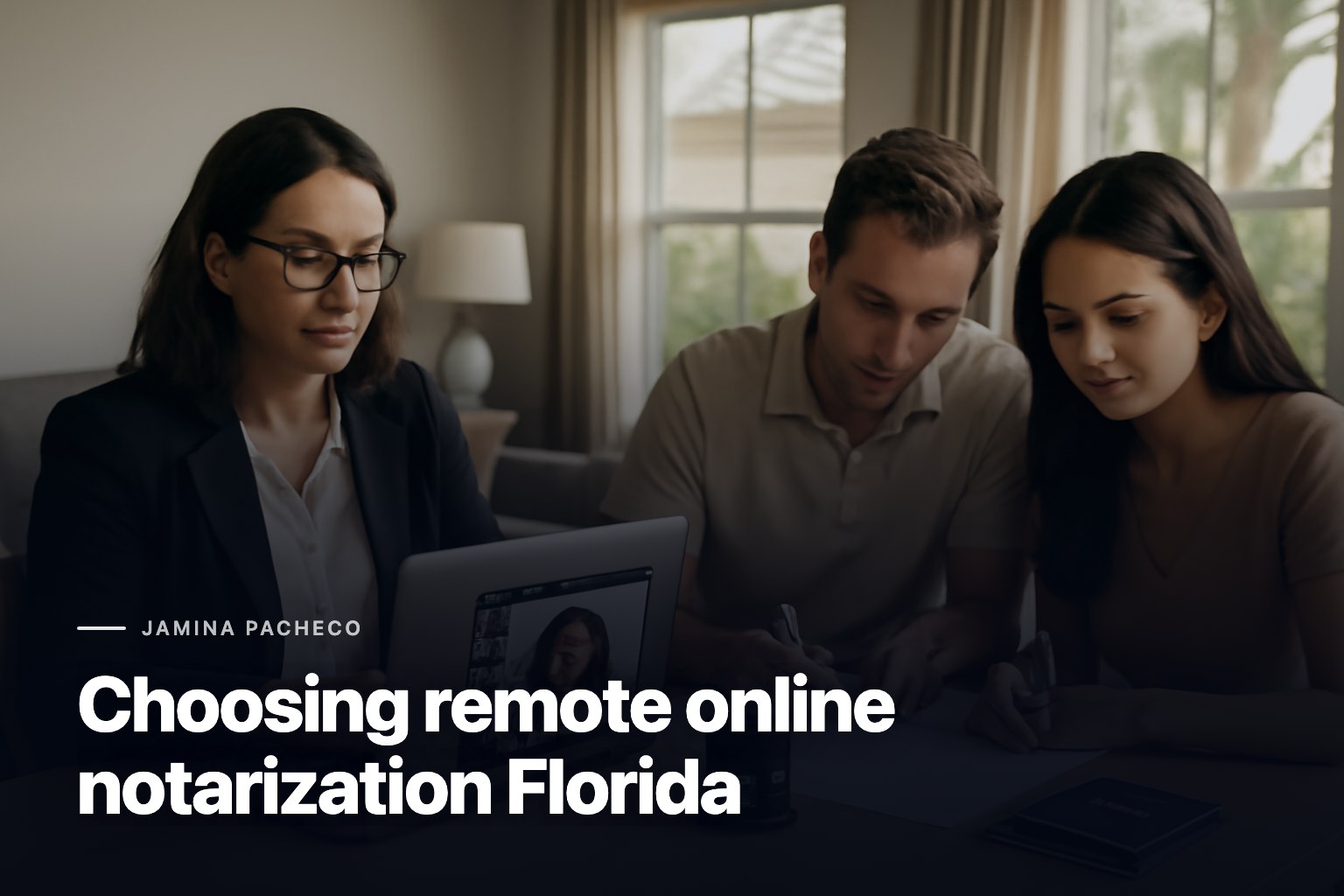
If you need to sign today and can’t cross town, remote online notarization Florida can save you time—but it can also complicate things if you pick the wrong platform or notary. The difference between a valid signing and a stalled document often comes down to very specific details.
- Verify that the service is authorized to perform remote notarization in Florida.
- Confirm which document you need to sign and whether it can be notarized remotely.
- Review the ID, video, and signing process before booking.
- Ask for clarity on language, platform, and estimated time.
- Keep a copy of the receipt and the notarized document for your records.
If you’re in Orlando or elsewhere in the state, what matters is not finding “the fastest service,” but one that lets you sign safely, without surprises and without losing an appointment because a requirement was missed. That’s where a smart choice makes all the difference.
How to recognize a trustworthy remote online notarization Florida
The first sign of trust is not a flashy promise, but how clearly the process is explained to you. A reputable service tells you from the start whether your document can be signed by video call, what ID you need, and what happens if the document has blank spaces or signatures already on it.
The communication channel also matters. If they reply quickly, ask specific questions, and don’t dodge the steps, you’re usually dealing with an organized operation. If, on the other hand, they tell you to “upload it and we’ll see” without reviewing anything, it’s best to pause before paying or booking.
In Florida, remote notarization does not work like an informal video signing. It must follow a technical and legal process, with identity verification, recordkeeping, and session control. The Florida state website and the National Association of Secretaries of State guide are useful references for understanding the general framework and telling a real service from an improvised one.
Requirements to review before booking
Before you reserve your appointment, it’s worth looking at the document carefully. Not all papers are suitable for remote signing, and not every case is handled the same way. A power of attorney, an affidavit, or certain personal forms may be eligible, but a document with incomplete instructions or missing details may force you to repeat the whole process.
Remote online notarization Florida usually requires three basic things: valid identification, stable internet access, and a device with a camera and microphone. If one of those pieces fails, the session can be delayed or canceled. In sensitive transactions, such as mortgage closings or loan signings, that interruption is not just annoying—it can shift deadlines and create extra costs for other parties involved.
Identification and exact name
The name on your ID must match the document you are signing. If you use a name with a second surname, initials, or a common variation, that should be checked before the appointment. A small mismatch may force a correction or require the session to be redone.
Signing device and environment
You don’t need a professional studio, but you do need a place where you can hear, see, and speak without interruptions. The camera should show your face clearly and the audio should let you understand instructions without having to repeat everything twice. If you plan to sign from a phone, make sure you can hold it steady or use a stand.
Document type and purpose
Don’t sign “just to test it” and see if it works. First confirm what you are signing and what it will be used for. A document for local use does not have the same path as one that will later go to another state or another country; in that case, you may also need to check whether an apostille is required after notarization.
Common mistakes that make signing harder
The most common mistake is assuming that any digital file can be notarized without review. When the document has blank spaces, out-of-order pages, or conflicting instructions, the notary cannot improvise. The session can only move forward if the document is ready and the signer understands what is being authorized.
Another frequent misstep is waiting until the last minute. If you need the signature for an urgent matter, schedule enough time to review the name, date, notarial wording, and delivery format. Especially if the document is part of a mortgage closing or a travel authorization, a small mix-up can hold up third parties who depend on your signature.
I also see issues related to technology, not the substance of the transaction. An unstable connection, a blurry camera, or a platform that won’t open in the right browser can turn a short process into a frustrating session. If you’re going to use remote online notarization Florida, it’s worth doing a quick audio and video test before the agreed time.
Don’t overlook language. If you want to sign in Spanish, look for Spanish support from the start; if you prefer English, the same goes. Switching languages halfway through the session can create unnecessary confusion, especially with powers of attorney, oaths, or family authorizations.
When to use RON and when not to
Remote online notarization Florida is often a good option when both you and the document can move forward without being physically present and when you need to handle things from Orlando, another city in the state, or even from outside Florida, as long as the transaction allows it. It’s especially helpful when someone is traveling, caring for a relative, working under tight hours, or needs to sign without driving across town.
For matters such as powers of attorney, affidavits, certain consents, and personal documents, the remote format can offer real speed. It also helps when several people are coordinating a signing from different locations and you want to reduce the time lost to travel, parking, and waiting.
There are, however, cases where an in-person signing or mobile service at your location makes more sense. If someone is not comfortable with technology, if there are hearing or vision issues, if the paperwork requires direct physical handling, or if the family dynamic is tense and needs a more controlled setting, an in-person visit can prevent mistakes. In Orlando, that practical judgment matters just as much as speed.
When what you need is a public notary solution in Spanish and English, with in-person, mobile, and remote options, a simple comparison of the formats saves you from impulsive decisions. On the notary services page, you can review which type of service best fits before booking.

Signs of a professional process in Orlando
A well-run process starts before the video call. You’re asked to review the document, confirm your identity, understand the sequence, and know what happens after the signature. That preparation keeps you from wondering whether the file is complete, whether a page was missed, or whether you need an extra copy.
It’s also worth paying attention to how you’re treated. Clear support, in Spanish or English, greatly reduces the margin for error when the document contains sensitive wording. Jamina Pacheco works with exactly that approach in Orlando and Central Florida: handling everyday notarial tasks without turning them into an obstacle course.
If you also need something beyond the remote session, such as an at-home visit, a power of attorney, or an apostille after notarization, it’s better to know that before you begin. That way, you won’t request a service that doesn’t match what you actually need. The remote online notarization page explains the service scope in more detail.
What to ask before booking
- Can my document be notarized by video call?
- What ID do you accept, and how should it be shown?
- Is the session recorded, and how will I receive the final document?
- Do you offer Spanish support if I need guidance during signing?
- Do I need to prepare anything in advance, like witnesses or extra copies?
Asking these questions does not slow the process down; on the contrary, it prevents the typical emergency call when you are already in front of the screen and discover something was missing. It also helps you compare providers without focusing only on price or an attractive ad.
Documents that usually require extra care
Powers of attorney deserve special attention because they authorize someone else to act on your behalf. If the agent’s name, the scope of authority, or the signer’s identification is unclear, the document may lose its usefulness right when it is needed most. To review that type of transaction, the powers of attorney page may be helpful.
Apostilles also deserve separate review. They are not part of notarization itself, but many people confuse them with the notarial act. If your document is leaving Florida and must be valid in another country, it must first be signed and notarized correctly; after that, you can determine whether an apostille is needed. The apostilles information can help you understand that sequence.
For family documents, such as a minor travel permission, the margin for error is even smaller. A misspelled surname, a wrong date, or a signature in the wrong place can create problems when the document is presented to airlines, border authorities, or government officials. That is why the review before signing matters just as much as the final signature.
There are also transactions that require special precision, such as mortgage closings and loan signings. In those cases, format, order, and coordination with other parties cannot be left to chance. If that is your situation, it’s worth reviewing the mortgage closings and loan signings page and confirming that the chosen format matches the closing schedule.
How to compare options without taking shortcuts
Don’t choose based only on immediate availability. An appointment that is too easy to get, with no prior questions or basic guidance, can end up costing more if the document does not qualify and you have to do everything over again. Don’t let the promise of speed be your only guide; speed only matters if the signing is done correctly.
A good way to compare is to look at three things: clarity of the process, compatibility with your document, and support in your language. If an option offers all three, you’re on the right track. If it asks you to decide without reviewing anything, it is probably selling convenience in appearance only, not reliable notary work.
For people and families in Orlando, having a local reference also helps. If you need to switch between in-person, mobile, and remote options depending on the transaction, a brand with a real presence and direct contact saves time otherwise wasted on automated emails or generic forms. You can learn more about Jamina Pacheco if you want to see the working approach behind the service.
And if you prefer to keep reading before deciding, the blog is often useful for understanding common situations without unnecessary jargon. When the process is simple, that reading helps you get oriented; when it is delicate, it helps you prepare better for the appointment.
Frequently asked questions about remote online notarization Florida
Is remote online notarization Florida suitable for any document?
Not for every document. It depends on the type of document, who is signing, and the final purpose of the transaction. Some personal and notarial documents work well in the remote format, but others require a specific review before booking.
Do I need to be in Florida to sign through RON?
Not always, but the validity of the act depends on the rules that apply to the signer, the notary, and the document. That’s why it’s best to confirm the specific case before assuming it can be done from anywhere.
What happens if my ID does not match the document exactly?
That detail can delay or block the notarization. If the name appears with variations, different surnames, or initials, it must be reviewed before the session so the notary does not have to stop the process.
Can I use remote online notarization Florida for a power of attorney?
Yes, in many cases it can be a useful option, as long as the document is ready and the transaction fits the remote format. A power of attorney requires special care because it authorizes specific actions by another person.
Does remote signing replace an apostille?
No. They are different steps. Notarization validates the signature before a notary; the apostille is another later step used when the document must be valid in another country.
What should I do if I prefer Spanish support?
Ask for it from the first contact. That way, you avoid confusion during the session and can sign with more peace of mind. If you want to coordinate your case from Orlando, review the option to book an appointment and explain the type of document you need notarized.
If your document is already ready and what you need is to sign without wasting time, book an appointment is the next step to see whether remote notarization fits your case. The sooner you confirm the type of transaction, the less likely you are to have to repeat the signing or look for a last-minute alternative.
If you’d rather talk through your transaction before committing to the session, at Jamina Pacheco you can arrange support in Spanish and English for remote, in-person, or mobile notarization in Orlando and Central Florida.
Was this useful?
If you need help with this in Orlando, I'm glad to take care of it.