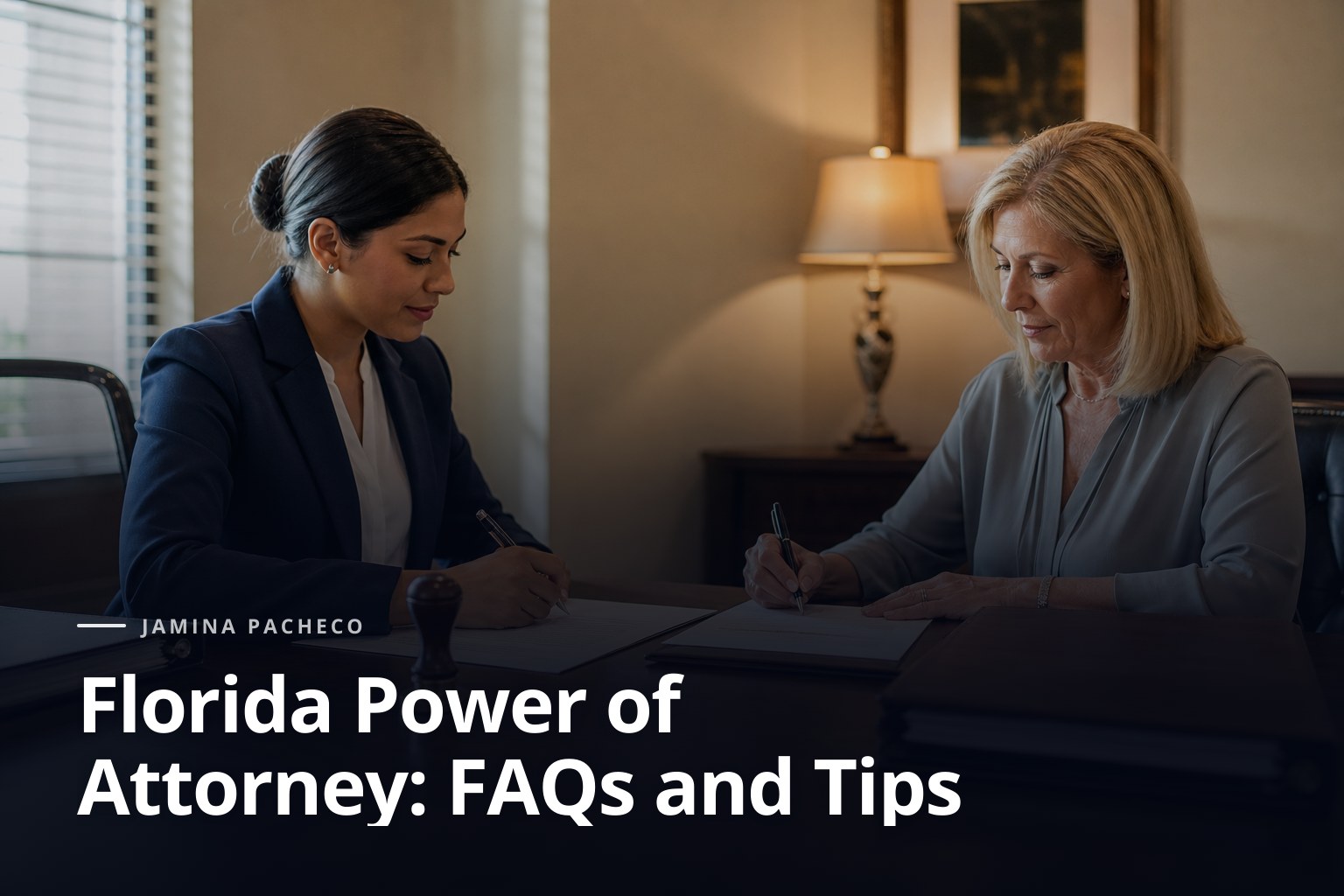
Florida Power of Attorney: FAQs and Tips
Clear up Florida power of attorney questions: signing, validity, common mistakes, and when to choose in-person, mobile, or online notarization.
If you need to sign something today, but the person who must act for you is outside Orlando, in another state, or even in another country, a Florida power of attorney stops being a theoretical formality and becomes a practical decision. A bad format, an out-of-order signature, or an ID that does not match can stop the document right when you are in the biggest rush.
- The power of attorney must match the purpose of the transaction and the person who will use it.
- The notarized signature requires valid identity and, depending on the case, witnesses.
- A small mistake can make the document useless to the bank, office, or attorney receiving it.
- Florida allows in-person, mobile, and remote online notarization options in certain cases.
- If the document will be used outside the United States, it may need an apostille after notarization.
Many readers come in with a simple question: “Will this work for what I need to do tomorrow?” That is the right question. Before signing, you need to think about who will act, which institution will receive the document, and whether it will be used inside or outside Florida. Once you understand that path, the process stops feeling like a race against the clock.
Florida Power of Attorney: FAQs and Real-World Decisions
In a Florida power of attorney, the difference between “works” and “doesn’t work” usually comes down to details that are easy to miss: names that match the ID exactly, clearly stated powers, the correct date, and signatures in the right place. A notary public does not draft the power of attorney for you or decide which powers you should grant; their job is to certify the signature, verify identity, and follow the applicable law.
If the document is already prepared, the next step is to check whether the format fits the intended use. Authorizing someone to handle a one-time banking task is not the same as granting broader authority to manage personal or financial matters. The level of care also changes when the power of attorney will be presented to a financial institution, a government office, or a third party that tends to require more precise wording.
One source of confusion is validity. Some people believe that “as long as it is notarized, every institution should accept it.” In reality, the recipient may require additional conditions: the signer’s identification, witnesses, an oath, a certified copy, or an apostille if the document is going abroad. That part is not made up by the notary; it is required by the receiving party.
How to Prepare the Document Before Signing
Before scheduling an appointment, check that the signer’s name appears exactly as it does on the ID. If there is a middle name, a hyphenated surname, or a difference between a passport and a driver license, it is best to correct it before the meeting. A name mismatch is one of the most common reasons the process gets complicated when the document is actually used.
It is also worth confirming that the text clearly identifies the authorized person and what they will be allowed to do. If the power of attorney is too vague, the receiving institution may request a more specific version. If it is too broad and you only needed something limited, you could end up giving more authority than intended.
In Florida, the notary must see the signer in person or work under a legally allowed method, such as remote online notarization when the document and situation allow it. For many readers, that option avoids delays, especially if the person is outside the city or has trouble getting around. If you prefer an on-site visit, mobile notary service solves signatures at home, in the office, at a hospital, or in a care facility.
Before the appointment, have the basics ready: valid ID, the complete document, and, if this is a power of attorney that will later go to another country, think ahead about whether you will need apostilles. That step helps you avoid having to sign again later because of a detail you could have planned for from the start.
When a Power of Attorney Needs Notarization, Witnesses, or an Apostille
Not every power of attorney follows the same path. Some documents require only a notarized signature; others also require witnesses; and others, if they will leave the United States, need an apostille so the receiving country can recognize the authenticity of the notary’s signature. The point is not to “do more paperwork,” but to provide exactly the support the document needs to be accepted where it will be submitted.
In Florida, an apostille makes sense when the power of attorney or any notarized document will be used in another country that is part of the Hague Convention. If the destination is not part of that system, the process may be different. That is why it is smart to check the final destination before signing, not after. The Hague Apostille Convention explains the general framework for this international recognition.
Another common mistake is thinking an apostille can fix a defective document. It cannot. If the power of attorney is signed incorrectly, has inconsistent names, or uses a format the institution does not accept, the apostille will only certify the notary’s signature; it will not correct the content. That is why you organize the document first and legalize whatever is needed afterward.
If the transaction involves estates, accounts, real estate, or mortgage closings, the level of review goes up. In those cases, both the text of the power of attorney and the signing process matter, including the order of signatures. In some cases, the recipient will ask for in-person notarization even if the law allows another method, because their internal policy is stricter. In those situations, it is best to confirm the requirement before arranging the appointment.

Common Mistakes That Delay a Florida Power of Attorney
The first misstep is showing up without knowing exactly which document will be signed. Many transactions are delayed because the person thought a generic sheet would be enough and later discovers the bank, school, or receiving institution expected different wording. If the recipient already gave you a specific format, use it; if not, ask for it before signing.
The second mistake is using an expired or unacceptable ID. The notary must verify identity with a valid credential, and if the ID does not qualify, they cannot proceed even if everyone is in a hurry. Problems can also come up when the name on the ID does not match the name on the power of attorney, when the usual signature looks very different, or when the signer is not physically present for a method that requires it.
Another common problem appears when someone tries to sign on behalf of another person without being authorized. A notary cannot “let it slide” just because the family asks or because the matter seems urgent. The authority to act must exist before the signature, not after. If there is any doubt about who can sign, the process should stop and be clarified first.
Rushing also works against you. If the document needs witnesses, an apostille, or a second visit because of a content error, the real cost is not just the time lost: it can be a stalled sale, a rescheduled medical appointment, or a postponed closing. In loan transactions, for example, those delays matter more than the notarization itself.
When the matter is sensitive, a pre-check saves time and back-and-forth. In Orlando, Jamina Pacheco helps individuals and families sign clearly, without improvising at the signing table. There is no need to overcomplicate the process; it just needs to be organized.
In-Person Signing, Mobile Service, or RON: How to Choose
The best option is not always the most convenient one, but the one that fits the document and the moment. If you can travel and the transaction is simple, in-person signing is usually the most direct route. If the person is at home, in a hospital, or in an office with rigid hours, mobile notary service can solve the problem without turning the appointment into a logistical headache.
Remote online notarization (RON) is useful when the law and the type of document allow it and when a video call fits the signer’s situation. For someone who lives far away, travels often, or needs to avoid getting around town, that option can save time. Even so, not every document or every person is automatically eligible for RON; it is worth checking whether the specific case allows it before booking.
There are situations where the practical answer is simple: if the recipient is strict, if an apostille will be needed, or if it is a mortgage closing, it is worth confirming the full path before signing. If the margin for error is small, it is not worth improvising with the fastest option just because it seems easy. A document signed correctly the first time always beats a rushed signing that has to be repeated later.
For anyone who needs guidance on which service fits best, the services section helps you match each transaction to the type of document and the place where it will be signed. And if you want to read first before scheduling, the blog brings together useful topics that explain common situations without beating around the bush.
What Banks, Schools, and Foreign Documents Usually Ask For
Every institution looks at a power of attorney through its own lens. A bank usually focuses on the signer’s identity, the clarity of the authorization, and the exact wording of the powers. A school may focus on the validity of authorization for a minor. A document that will go abroad, on the other hand, often triggers questions about the notary, apostille, and sometimes additional formatting.
That is why you should not assume a Florida power of attorney “works for everything.” It works for what the text says and for what the receiving institution accepts. If it will be used abroad, the usual path is: correct signature, correct notarization, and, when needed, an apostille. If it will be presented to a financial institution, it may help to confirm whether they require specific wording or an in-person signature before the notary.
If the matter involves family, such as minor travel authorization, travel consent, or one-time permissions, the document format matters a lot. A notarial authorization that is misunderstood can create more questions at the counter or at the airport than answers. In those cases, it is safer to review the specific purpose first and then choose the right service, such as a minor travel consent when appropriate.
When the transaction involves real estate or loan signatures, time and accuracy matter even more. A signing error at closing can force you to redo entire pages or reschedule the delivery. If that is your situation, the mortgage closings and loan signings service is designed to handle signing packages in an orderly way and without unnecessary delays.
Frequently Asked Questions About Florida Power of Attorney
Who can sign a power of attorney in Florida?
The person granting the authority can sign it, as long as they have the capacity to do so and valid identification for notarization. The notary verifies identity and willingness, but does not replace the legal judgment about who is allowed to grant it.
Does a Florida power of attorney work in another country?
It may work, but it often needs an apostille or additional requirements depending on the destination country. Before signing, it is a good idea to confirm where it will be submitted and what that authority or institution requires.
Does the notary draft the power of attorney?
No. The notary should not prepare the legal content of the document or tell you which powers to include. Their role is to notarize the signature and verify that the act meets the applicable requirements.
Can I sign by video call?
Only if the case and document allow remote online notarization under Florida law. Not every power of attorney allows that method, so it is worth confirming before booking.
What if my ID has a different name?
It can lead to a refusal or delay until the difference is clarified. The best approach is to review the document, the ID, and the name that will appear in the signature before the appointment.
Do I need witnesses?
It depends on the type of power of attorney and who will receive it. Some documents and some institutions require them, while others do not. Check the requirement before you come in to sign.
Does an apostille correct document errors?
No. An apostille only certifies the authenticity of the notary’s signature or the appropriate official’s signature. If the power of attorney has content or signature errors, those must be fixed first.
Where can I get help if I am in Orlando or nearby?
If you need a smooth, straightforward transaction in Orlando, you can schedule an appointment with Jamina Pacheco for in-person, mobile, or online signing, depending on the case.
If you already have the document ready and only need to sign it correctly, schedule an appointment is the most direct way to avoid delays caused by identification, signing method, or apostille. When a Florida power of attorney has to be done right the first time, it helps to coordinate the right service based on where the person is and where the document will ultimately be used.